Search for anything

Scavenge your bliss
Showing posts with label chemistry. Show all posts

Wednesday, January 28, 2015

New type of atomic bond confirmed - vibrational bond

This is a total mind blow. Most armature scientists know of the main types of bonds, and most of us agree things happen faster when everything is hotter. Well scientists working on a atomic accelerator noticed something a bit strange.

What does this mean in the real world? No idea but I could lead to further findings and maybe the secret to the speed of light.


Read the whole story here http://www.scientificamerican.com/article/chemists-confirm-the-existence-of-new-type-of-bond/


Chemistry has many laws, one of which is that the rate of a reaction speeds up as temperature rises. So, in 1989, when chemists experimenting at a nuclear accelerator in Vancouver observed that a reaction between bromine and muonium—a hydrogen isotope—slowed down when they increased the temperature, they were flummoxed.

Donald Fleming, a University of British Columbia chemist involved with the experiment, thought that perhaps as bromine and muonium co-mingled, they formed an intermediate structure held together by a “vibrational” bond—a bond that other chemists had posed as a theoretical possibility earlier that decade. In this scenario, the lightweight muonium atom would move rapidly between two heavy bromine atoms, “like a Ping Pong ball bouncing between two bowling balls,” Fleming says. The oscillating atom would briefly hold the two bromine atoms together and reduce the overall energy, and therefore speed, of the reaction. (


Tuesday, August 13, 2013

Silicate Part 2 - Sorosilicates


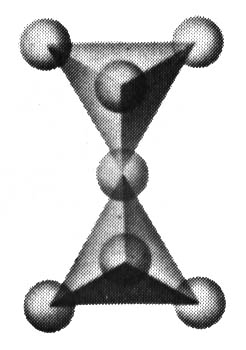
After the Neso and Ortho silicates come the Sorosilicates.
These are less in number than the first type of silicon mineral and their crystal structure is a bit more complex. Their structure is more like isolated clusters of double tetrahedra  that attach at the points where they can share an oxygen molecule.

Tanzinite (Ca2Al3(SiO4)(Si2O7)O(OH)) is an example of a Sorosilicate. Not exceedingly interesting but these double tetrehedra are the next step in the silicate family. From here on out the structure gets more complicated quickly.   

Monday, October 3, 2011

Working in my first laboratory


Quality Control on iron is generally know as Metallugy.
Metallurgy is the study of...metal! More specifically the alloys and percent ratio of elements that combined to make metal have certain electrical, thermal, or ductile properties.Depending on the part that is being made determines what sort of properties that part needs to have. Example: pieces close to the engine need to be able to absorb a lot of heat.


My first real job out of college with my degree in geology and earth science is a little more than a step above what I could easily do with my high school diploma....but at this rate any job getting paid more than 8.50$ is a step in the right direction.
Everyday I get to analyze iron samples for chemistry and make sure the samples fall within specific ranges in order to determine if the iron is "good" or "bad". Usually the iron samples fall within the range, but every so often someone makes a mistake and the lab must capture the discrepant iron.


This is the spectrometer...it uses an argon spark in order to 'excite' the electrons of particular elements and then fiber optics read and interpret the amount of energy caused by the argon.